
How to Choose Binoculars for Astronomy
Before you start check out the range of binoculars for astronomy that are currently on the market you need to consider the distance you are looking to cover and what level of detail you are hoping to see. If you can imagine that a telescope can provide you with a significantly larger aperature (objective lens) and a wide range of magnification abilities it’s understandable that for viewing over longer distances, and to see the finer details, a telescope is often a better option. However that said binoculars can prove useful, even for the serious astronomer, and are an inexpensive way to get started.
The real pro’s of using binoculars for astronomy is the minimal set up time, the relatively low cost, portability and the fact that there isn’t an endless list of accessories that you need to buy.
Manufacturers generally indicate whether or not their binos are suitable binoculars for astronomy but as a general guide you want to be looking for giant binoculars or binoculars with an objective lens that is 50mm or greater. 10x50’s are often a popular choice for astronomy as they are reasonably comfortable to hold yet powerful enough for the basic astronomers needs.
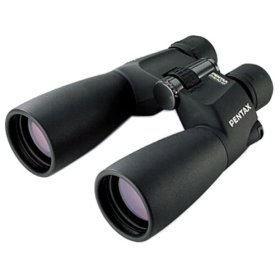
Some manufacturers do make smaller binoculars for astronomy such as the Pentax PCF 8x40 or the higher quality Pentax DCF SP 8x43 and Olympus rate their EXPS I 8x42’s as excellent astronomy binoculars. As a general rule, and particularly relating to the smaller binos, if the objective lens is 5 times or more than the magnification you can use them for astronomy.
If you are looking for a real meaty beast then the Celestron Skymaster series ranges from 15 x 70 up to 25 x 100 (which offers the power of a small telescope) and Nikon do the 10 x 70IF SP which is considerably more expensive (around £1200 versus up to £400 for a Skymaster) but you are paying for the quality of the lenses and the superior optical design (one of the leaders in it’s class). The bigger you go when you are looking for binoculars for astronomy the greater the power and light gathering abilities so if you opt for a 25 x 100 (25x magnification, 100mm objective lens) you will be able to see further and view objects in greater detail than with a 7 x 35 or a 10 x 50 (for example).
Binoculars for Astronomy, quick check list: · Fully multi-coated lenses are a must · Waterproof binoculars are generally best if you want to prevent fogging and view in all weather conditions. · The best astronomy binoculars come with Bak-4 Porro prisms (Bak-4 glass is high quality glass and porro prisms generally provide greater light transmission and a sharper image than their roof prism counterparts) · Always check a binoculars suitability for astronomy · Remember the more powerful the better and if you want a performance similar to a small telescope buy a binocular with the largest possible objective lens. · For larger binoculars make sure you check tripod / mounting requirements. · Quality optics is important and no more so than for astronomy. If you can afford high quality binoculars they are well worth paying for.
VIEW ASTRONOMY BINOCULARS Canon Binoculars / Nikon Binoculars / Celestron Binoculars / Pentax Binoculars / Olympus Binoculars / Bushnell Binoculars / Swarovski Binoculars / Steiner Binoculars Waterproof Binoculars / Marine Binoculars /Bird Watching Binoculars / Astronomy Binoculars / Digital Binoculars / IS Binoculars / Compact Binoculars / Zoom Binoculars
| ||||
|
 When buying
|
Shop by Brand |
|
Canon Binoculars |
|
Shop by Price |
|
Binoculars under £100 |
|
Shop by Type |
|
Astronomy
Binoculars |
| By Activity |
| By Price Range |
|
Under £100 |
| Popular Sizes |
| Reviews |
| How To |
|
Clean Binoculars |
| Resources |